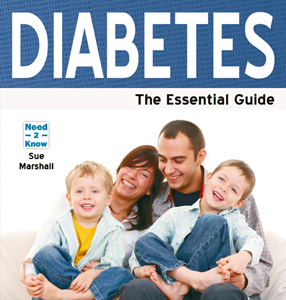
All You Need To Know About Diabetes

With over 2 million people diagnosed with diabetes in the UK, and a further 1 million undiagnosed, this is obviously a serious and rising problem. There is a lot of information around about diabetes, indeed I pass on frequent health News about it, but there is a new book that I think will be extremely helpful for patients and their families and carers.
Diabetes – the essential guide has been written by someone who knows all about it as the author, Sue Marshall, was diagnosed with type I diabetes at the age of five. Now 41, she has lived with this condition for more than 35 years so is well qualified to offer advice and understanding on how to deal with the condition.
It is an extremely practical book, containing information about symptoms, diagnosis, types of diabetes and blood testing. It offers information on the types of medication available, and practical advice on how to manage the condition. Special sections on dealing with travelling, being away from home, pregnancy, and children with diabetes are well handled and looked at in detail.
As I found with my own stress book, what people need when dealing with any medical condition is clear, concise and easy to access information — no waffle and no padding. This book certainly delivers that and once you have read through the book and got some understanding about how your diet affects your blood sugar and what you can actually do to handle it successfully you have a practical plan to follow.
Diabetes – the essential guide costs £8.99 from bookshops or direct from the publisher’s website at need2knowbooks.co.uk and Sue Marshall has her own webbsite where she gives information on diabetes health care and related products. You will find it at www.desang.net
Cool Down with Sun Tea
June 29, 2010 by AnnA
Filed under Food & Nutrition

Ever optimistic I see the sun and immediately break out the long-standing sun tea recipe! Tea brewed in the sun really does have a lovely gentle flavour and once in the fridge with lots of ice cubes you will find it a very refreshing, and healthy, drink on a hot day. So instead of reaching for a can of fizzy or a hot cup of tea try this recipe from the southern United States where they know a thing or two about staying cool in extreme temperatures. I first came across it when I was doing an exchange with a women’s’ college in Missouri as a writer in residence and have been making it ever since.
Sun Tea Recipe
The first and most important thing to say is that you must use a glass container that will hold around a litre of water — never, ever, plastic as the sunlight will leach toxins from it into the water. So one large glass container with a lid or cover the top with a saucer if you don’t have one. It could not be simpler, put 4 to 6 teabags into the jar and top up with cold, preferably filtered, water. You can use any teabags, but what I think works best is either green tea or herb tea and personally I use a mixture of the two..
Leave it to brew and steep for 3-6 hours and you will know your tea is ready when the colour has reached the colour of tea as if it was brewed in a tea pot with boiling water.
Sun Tea tends to be a bit milder tasting than normal brewed tea and although you can serve it warm from the sun, I prefer it served with ice and a lemon slice and a few sprigs of mint. Once brewed, but it in the fridge and enjoy it over the next day or two and if you are not sure about what herbal teabags to use then fennel gives an interesting aniseed taste along with the green tea, lemon balm is nicely mild, or any of the spiced tea bags such as the Ayurveda is detox teas. If you are concerned about your high blood pressure, then try mixing the green tea with a couple of Hibiscus teabags as they are known to help reduce it.
How A Good Night’s Sleep Can Literally Save Your Life

We all know the value of a good night’s sleep, without it we don’t function at are best and are more prone to illness. But did you know that if you have chronic insomnia then you have a three times higher risk of death than those who get a full 8 hours and that only getting a full six hours can impact your ability to think clearly the next day?
Sadly, insomnia is extremely common as up to a -third of adults say they get less sleep than they need to function at their best. Insomnia is usually not an isolated incident but a persistent condition and 75 percent of people with insomnia say they have it for at least one year, with half suffering for three years.
Insomnia can include all these symptoms:
1. Difficulty falling asleep
2. Waking frequently during the night
3. Waking too early in the morning and not being able to get back to sleep
4. Waking feeling unrefreshed
Insomnia will affect your hormone levels and accelerate aging, and may also play a role in diabetes, depression and cancer. Too little sleep impacts your levels of thyroid and stress hormones, which in turn can affect your memory and immune system, your heart and metabolism, and much more — including your risk of cancer. New research now also shows that sleep deprivation leads to changes in the levels of key proteins that can trigger migraines.
A disrupted circadian rhythm, or sleep/wake cycle, may influence cancer progression through shifts in hormones like melatonin, which your brain makes during sleep. There’s also the issue of melatonin, an antioxidant that helps to suppress harmful free radicals in your body and slows the production of estrogen, which can activate cancer. When your circadian rhythm is disrupted, your body may produce less melatonin and therefore may have less ability to fight cancer.
Exposure to light during the night can also reduce melatonin levels, which is why it is important to sleep in total darkness to decrease your risk of cancer. An important hormone that is affected by a disrupted circadian rhythm lies is cortisol, which normally reaches peak levels at dawn then declines throughout the day. It is one of many hormones that help regulate immune system activity, including insulin and researchers have repeatedly shown that insufficient sleep will result in an increased rate of diabetes due to increased insulin resistance.
The key to dealing with insomnia, without first resorting to sleeping pills, is to address the underlying cause and these are the most common culprits:
• Stress is the prime reason for sleeplessness as your brain continues to worry at your problems through the night.
• Overactive adrenals, due to stress, keep you on the alert, and that makes it difficult to sleep
• Poor environment in the bedroom doesn’t help either so ban electrical and electronic devices and no using your mobile, watching tv or doing emails on the laptop in bed. These activities stimulate your brain, making it difficult to then fall asleep. Make sure the bedroom is dark, and cool for optimum sleep.
• Give your stomach a rest and don’t eat for at least two hours before bed, and preferably longer. The later you eat, the harder your digestive system works to deal with the food when ideally it wants to be doing essential repair and maintenance. Eating late at night will keep you awake and if you must do so then eat something that is light and easily digested. aches and confusion, and may also cut your amount of deep sleep, interfering with your body’s ability to refresh itself.
Natural Help for Insomnia
There are a number of well-tried and tested remedies from foods to supplements. Nothing works for everyone, but try these favourite methods and see what works for you:
Herbs — the most popular are valerian nd hops, and if your insomnia is linked to stress and worry then you could try two excellent supplement: Quiet Life by Lanes or Total Calm from Gematria. Chamomile tea is also soothing but try not to drink just before bed so your bladder doesn’t wake you in the night.
Dietary help – help yourself by cutting out stimulants at night, particularly caffeine and sugar. Eat foods that help you sleep and contain tryptophan, an amino acid that is a precursor to serotonin, which is then converted to melatonin. Eat magnesium-rich foods as it is a natural sedative and deficiency can result in difficulty sleeping, constipation, muscle tremors or cramps, anxiety, irritability, and pain. It has also been useful for people with restless leg syndrome. Magnesium rich foods include legumes and seeds, dark leafy green vegetables, wheat bran, almonds, cashewsbrewer’s yeast, and whole grains.
Create a calm atmosphere – get as relaxed as you can before you slip between the sheets so try some meditation before bedtime or a warm, not hot, bath with soothing aromatherapy oils like lavender. If you have a cd player/clock then put on some gentle, slow music on a low setting as it has been found to improve sleep quality and length and reduce frequent waking intervals.
How to reduce your risk of Alzheimer’s

I am always in favour of prevention rather than cure and there is now significant evidence that lifestyle and diet may play a role in reducing your risk of developing this increasingly common condition. Just as a heart-healthy diet reduces your risk of heart disease, a similar diet seems to also contribute to Alzheimer’s prevention by reducing some risks. The same medical conditions (diabetes, high blood pressure, high cholesterol) and lifestyle factors (lack of exercise, poor diet, smoking, obesity) that lead to stroke and heart disease also lead to a higher risk of developing Alzheimer’s disease. This is because the factors that affect blood vessels throughout the body also affect blood vessels in the brain.
In the latest study, published in April 2010, over 2,000 elderly New Yorkers who were dementia free were followed for almost 4 years. In that time, 253 subjects developed Alzheimer’s disease, and the dietary patterns of all subjects were characterized and analyzed. They don’t say at what point elderly begins, but I will be generous and assume that all their subjects were over the age of 60, but the common characteristics of a ‘brain-healthy’ diet generally avoids saturated fats and cholesterol, and emphasizes dark-skinned fruits and vegetables (rich in anti-oxidants) and coldwater fish (which contain omega-3 fatty acids).
The study found that those people who strongly adhered to this dietary pattern were 38% less likely to develop Alzheimer’s disease compared with those whose diet was significantly different.
If you want to minimise your risk of developing Alzheimer’s than basically you need to follow a modified Mediterranean diet. This means higher intakes of nuts, fish, tomatoes, poultry, cruciferous vegetables, fruits, salad dressing (oil and vinegar) and dark green leafy vegetables and a lower intake of high-fat dairy products, red meat, organ meat, and butter.
A previous study published in 2006, showed that people who most closely followed the Mediterranean diet had the lowest Alzheimer’s risk – 40% lower than those who were least likely to follow the diet. This diet places emphasis on eating fruits, vegetables, nuts, beans and grains with red meat and poultry eaten only rarely, and olive oil and fatty fish are the main sources of fat in the diet.
I think this is good news as once again it puts responsibility for our long-term health into our own hands — and hence into our stomachs. We have absolutely no control over our genetic inheritance or predisposition to certain diseases, but what we certainly can do is create the best conditions for optimal health through a health promoting — not health debilitating — diet.
A Healthier Way To Fry?
Many foods and oils are rich in tocopherols, but few contain significant levels of tocotrienols. In fact, most of the popular oils used in food preparation – olive, soybean, safflower, sunflower, corn, cotton and peanut – contain only tocopherols. The only oil that contains significant levels is palm fruit oil which is composed of 30 percent tocopherols and 70 percent tocotrienols. The oil is extracted from the flesh of the palm fruit, and is said to be the most widely used oil in the world, and althoughit may be new to the UK market, is well established in Malaysia, Japan, the USA, Australia and South Africa. You don’t need to go quite that far afield as I found it in the natural foods section of my local Co-op supermarket and can report that if you are frying food, particularly sautéed potatoes, it does give them a lovely golden colour.
Sorry about the almost pun, but given that we now consume a variety of different oils as part of our diet I thought you might be interested in Carotino, an oil that is naturally rich in alpha and beta carotenes (Pro-Vitamin A) and is high in healthy mono-unsaturated fats, low in saturates and is both GM, and free from cholesterol and trans fats. It is more heat stable than other vegetable oils, including olive oil, and can claim a number of health benefits as it is naturally rich in anti-oxidant Pro-Vitamin A and high in Vitamin E and Omega 3 & 6 and also contains Lycopene and Co-Enzyme Q10.

Carotino oil comes from red palm fruit – the world’s richest natural plant source of carotenes – and gives the oil a slightly reddish hue. I was a little startled by this on first using it to cook, but this shows it is an entirely natural product and that the Pro-Vitamin A hasn’t been processed out. When used in cooking can make a substantial contribution towards the Recommended Daily Allowance (RDA) of both Pro-Vitamin A and Vitamin E for adults. The vitamin E is important as it helps to rid the body of free radicals and protect it from cancer, cardiovascular disease, heart disease and other serious illness.
However there are two forms of vitamin E that each serve a unique purpose: tocopherols and tocotrienols. While tocopherols are the most common form, tocotrienols are just now beginning to emerge as being approximately 50 times more potent than tocopherols. Recent studies have shown that they distribute themselves more evenly than tocopherols do in the fatty layers of cell membranes and are effective at preventing and treating serious degenerative diseases like cancer, stroke-induced injuries, diabetes, osteoporosis and cardiovascular disease.
Many foods and oils are rich in tocopherols, but few contain significant levels of tocotrienols. In fact, most of the popular oils used in food preparation – olive, soybean, safflower, sunflower, corn, cotton and peanut – contain only tocopherols. The only oil that contains significant levels is palm fruit oil which is composed of 30 percent tocopherols and 70 percent tocotrienols. The oil is extracted from the flesh of the palm fruit, and is said to be the most widely used oil in the world, and althoughit may be new to the UK market, is well established in Malaysia, Japan, the USA, Australia and South Africa. You don’t need to go quite that far afield as I found it in the natural foods section of my local Co-op supermarket and can report that if you are frying food, particularly sautéed potatoes, it does give them a lovely golden colour.
Why Aeroplanes Can Make You Sick

No, I am not talking about turbulence – but that indeed can do the trick – I wonder if you’ve noticed that after any flight, particularly long haul, you get a headache, or have trouble breathing or would just feel mentally dull and confused? You may put it down to fatigue, but it now seems that it could be something as simple as you breathing in the toxic fumes that regularly circulate throughout many commercial airline cabins.
Guess what, you are not alone and it has now become a recognised condition with a new name of Aerotoxic Syndrome. It’s called a syndrome because there are a whole host of both acute and chronic symptoms that it is now believed are caused by breathing contaminated jet cabin air such as chronic fatigue, respiratory difficulties, vision problems and cognitive disorder.
That’s all very well, but what causes it? The basic reason is that airplanes fly thousands of feet above sea level where the air is cold and thin and in order to make it suitable for passengers to breathe it must be pressurized, heated, and then circulated to the cabin. On most commercial planes this is done by drawing in a compressed supply of air from plane engines and typically, this “bleed air” is mixed with existing cabin air and recirculated throughout the flight.
As you might imagine, this air is drawn is often contaminated with toxic fumes from the friction that occurs between various moving parts in the plane’s engine and the oil that lubricates them. Of course these compartments are designed with seals that block fumes from getting into the cabin, but like anything else they are not 100 percent effective and can and will break down over time, letting more and more oil mix with hot compressed air.
So what is actually in the air that you are breathing while sitting in your aeroplane seat?
The type of oil used to lubricate plane engines is a complex, synthetic variety that has been specially formulated to endure extreme conditions and has a number of toxic components, including Tricresyl phosphate (TCP), a known neurotoxin that is used in pesticides and nerve agents. Heavy metal particles such as nickel, cadmium and beryllium also make their way into the mix as the “bleed air” is drawn through engine channels.
The Aerotoxic Association claim that these toxins cause damage to the central nervous system though this will vary from person to person. Some people may experience immediate symptoms while others may notice a pattern of illness that becomes progressively worse over time. This is not something that is acknowledged or recognised by government and regulatory authorities as they feel there is not enough evidence that the toxic fumes circulating in airplane cabins are responsible for any sort of illness.
The evidence to date may be anecdotal but that doesn’t make it less real. There have been testimonies from pilots, air filtration experts, flight attendants and passengers that have been harmed by toxic cabin air. One such is Tony Watson, a former commercial airline pilot. Whose blood tests revealed that his body was filled with petroleum-related chemicals that led to severe neurological damage, leaving him unable to fly planes.
In the UK, the House of Lords made a request back in 2007 that the substances contained in cabin air fumes be analyzed to determine safety and a group from Cranfield University agreed to conduct the study and release the results by March 15, 2010, but it has yet to do so. The Aerotoxic Association fears that the report may never be released as the university has “close commercial partnerships with Airbus, BAE Systems, Boeing and Rolls-Royce, to name just a few”.
So if you want to avoid breathing in toxic recycled air which airline should you choose? Sadly, virtually all jet aircraft and turboprops use an air circulating system that is susceptible to toxic fumes and the only type of plane that uses non-bleed technology is the new Boeing 787 Dreamliner. This commercial jet is the first one in over 40 years to be created using safe technology, despite evidence since at least the early 1990s that bleed technology creates toxic cabin air.
My advice? During the flight, other than carrying your own personal oxygen mask, drink plenty of non-alcoholic fluids and take 500 mg of vitamin C when you board the plane and every two hours thereafter. Vitamins C is instrumental in helping expel toxins from the body, as is plenty of water. Check your body tolerance for vitamins C, signs you are at your limit include tingling on the tongue and/or mild diarrhoea. Some people can take up to 3 to 5 grams a day, but for most people starting at 500 and working up is much the best plan. Once arrived at your destination I would keep up the water and vitamins C routine for at least another 24 hours.
If you want to find out more you will find lots of fascinating information at www.aerotoxic.org
In A Wheelchair and Want A Dog?

The training organisation Dogs for the Disabled has added an enthusiastic introduction to the book: “Waggy Tails & Wheelchairs” – which I have to say could be bettered as a title — praising it as containing a wealth of tips that will prove invaluable information that any wheelchair or scooter user who is contemplating getting a dog would do well to read.
The author, Alexander Epp, became confined to a wheelchair at the age of 21 after a car accident but this didn’t prevent him from undertaking many tours on a handbike, complete with tent and accompanied by one or more stray dogs. This led him to acquiring his own dog and he is completely realistic about the work involved in having a dog, but it is very convincing that if the right strategies are in place, it will be a tremendously rewarding experience for both the individual and the dog.
Companionship is hugely important to all of us, whether fully mobile or confined to a wheelchair, and there is no doubt that dogs make a tremendous, loving, stimulating companions. But is it really a good idea to take on a dog, because there certainly are a number of things to consider from the cost involved to whether you have your own transport and how much help and care is available to you
Certainly, wheelchair and mobility scooter users face their own particular challenges when it comes to dog ownership: how will they walk their dog; train and teach it; play games with it, and, all importantly, how do you deal with the dog mess? –From his unique viewpoint, the author answers all of these questions and concerns and allows readers to assess and determine whether they can share their special lifestyle with a dog, and what they can do in preparation to make it as simple, easy and straightforward as possible
If you can’t find Waggy Tails & Wheelchairs – The complete guide to harmonious living for you and your dog by Alexander Epp in your local bookshop then go to the website at www.velocebooks.com and for every book sold, a contribution of 50 pence will be made to the Dogs for the Disabled charity.
New Natural Help for Urinary Problems

Whether you are a man or a woman, if you are having difficulty urinating or making seemingly endless visits to the bathroom every night then you know all about the inconvenience and embarrassment associated with this condition. Whether the problems are the result of incontinence, or frequent urination due to an enlarged prostate you might want to consider a new supplement called Pumpkin Seed Extract.
Research confirms that pumpkin seeds promote healthy urine flow, help reduce the frequency of toilet visits, strengthens weak bladder muscles that usually lead to incontinence, and, when used long-term, aid those suffering from Benign Prostatic Hyperplasia.
The use of pumpkin seeds as a natural diuretic aid is not new, but for something so small they are packed with beneficial elements. They contains high levels of amino acids, beta carotene, vitamin E, magnesium, calcium, zinc, potassium, copper, and manganese and are also rich in Omega 3 and 6 essential fatty acids, and phytosterols.
The key to their usefulness for urinary problems though is the fact that pumpkin seeds also contain curbicin, a substance structurally similar to testosterone, and oestrogen, which research shows helps strengthen bladder muscles, promote healthy urine flow, and reduce nocturia, regular night-time urination.
If you want to try it then this new supplement comes from Lifeplan and contains 30mg of pumpkin seed extract, equivalent to 300mg of fresh pumpkin seeds, and the recommended dose is to take one tablet twice daily, to either help maintain a healthy urinary system or to help rectify an existing urinary problem.
You should be able to find it in your local health store but if n do not go online to www.lifeplan.co.uk or call 01455 556281 for your nearest stockist.
9 Naturopathic Tips To Raising Energy Levels

Men’s Health Week is focused around physical activity and so Harley Street’s world leading naturopathic physician Harald Gaier is offering his tips on improving energy to raise awareness of the importance of looking after your health.
Following research by Men’s Health Forum, stating that men over the age of 35 tend to reduce the amount of physical activity they undertake, blaming pressure of work, stress, the divorce and children as the causes, Dr Gaier has some suggestions for how to help men to stay healthy. I have said it so often it must be imprinted on your brain cells by now, but physical activity has been shown to reduce stress and anxiety as well as decreasing the risk of cancer, heart disease and diabetes and can even improve sexual performance. I thought that last bit might wake you up!
Dr Gaier commented: “For practitioners of Herbal Medicine, preventing disease is not an afterthought: it is the cornerstone of such a healthcare practice. Natural Medicine practitioners are trained to be agents of life-style change. They treat illness promptly and aggressively when appropriate, but always seek to maximise the body’s innate capacity to stay healthy and resist disease and injury.”
So, bearing that in mind, here’s how to make a difference to your energy levels:
1 Water
Another old favourite that I can’t over-emphasise the importance as when your calls become dehydrated it saps your energy. Even slight dehydration of 1 or 2 % of your body weight can make you feel tired. Don’t wait until you are thirsty because if you feel thirsty, you’re already dehydrated and this can lead to fatigue, muscle weakness, dizziness and other symptoms
2 Exercise
Yes I know you’ve heard it all before, but that doesn’t mean it isn’t true. Exercise gets your heart pumping and increases your metabolism, but more importantly it releases endorphins which gives you that same happy sensation you get when you have sex or eat chocolate, for this reason your brain begins to crave it more. A great form of exercise for men is Yoga — and no it is not just for women in pink leotards, but has been a staple of a strong healthy body for men at all ages in India and increasingly in the West. A 10-15 minute yoga session in the morning will speed up your metabolism and has the potential to work out every muscle in your body – which your regular cup of coffee just can’t match.
3 Keep the weight off
Obesity can be the cause for a lack of energy, as this excess weight can slow you down and leave you feeling drained, tired and not to mention lowering your sexual self esteem.
4 Graze not guzzle
It’s important to maintain a normal blood sugar level and in order to do this you should eat every few hours. This will help you maintain muscle tissue, which burns more calories than fat tissue, and will help increase your energy levels.
5 Don’t neglect carbohydrates
With all the emphasis on high protein and low fat diets carbohydrates have been rather neglected, but they are an essential part of your daily diet. They provide us with the much-needed energy to power us through the day as they release energy slowly into your body to keep you going for longer.
6 Sleep: Although we all have different sleep requirements, there is an absolute minimum that the body needs for essential maintenance and rejuvenation during your rest period. The ideal if you can manage it is 8 hours a night but the average in the UK is only around 5-6 hours which means that your body isn’t fully alert which which has an impact on your stamina levels, and not for the better.
7 Avoid quick fixes
It is so tempting when you’re tired to reach for a cup of coffee or a sticky bun or her a piece of chocolate and psychologically this may well give you a boost however the physical reality is somewhat different. Your body will waste copious amounts of energy turning the sugar in the snack into energy to use in your body and the boost will be short lived, and inevitably leaving you more drained as it imbalances your blood sugar. The best things to keep in your snack drawer — what do you mean you don’t have one — I’m nuts, fruit or whole grain products.
8 Detox
The less your diet is 100% pure, organic and natural the reality is that you will be taking in toxins that stress and pollute our bodies. Toxins can have many effects that the most common are to make us feel lethargic and bloated at best and ill and depressed at worst. It’s a great idea to have a regular detox day at least once a week as the actor Larry Hagman used to do when he only ate fruit on Sundays. There are certainly plenty of detox diets available but you can just make it simple and spent one day having nothing but water, Herb tea, and fruit such as grapes, cranberries and pomegranates a as they are all effective at ridding the body of toxins.
9 Laugh
How do you feel after you’ve had a good belly laugh? That’s right, you feel good you feel energised and you feel lighter and that’s because it generates chemicals in the blood that boost well-being. Try to laugh at least five times a day — you can do if you try.
If Dr Gaier’s ideas appeal to you on how to improve your health then you can find out more at his website at www.drgaier.com or for the technically adept amongst you is also on twitter at www.twitter.com/drgaier
Natural Help For Arthritis from Rosehips
June 9, 2010 by AnnA
Filed under featured, Healthy Ageing

I am showing my age here, but as a child at school we used to collect rose hips every autumn and were paid a vast sum – a penny a pound I think – to hand them in. Child labour laws no doubt prevent that now, but with their very high level of antioxidants and vitamin C they have a range of uses – and a new one is in treating arthritis.
With 1 in 4 adults being diagnosed with either osteoarthritis or rheumatoid arthritis, and it accounting for 1 in 5 GP consultations, it is obviously a serious problem with up to 9 million people being affected in some way. Trials have confirmed the effectiveness of rosehips to help with the side effects of arthritis such as inflammation, reduced movement, and associated pain. Research supports the benefit of taking a rosehip supplement whether you suffer from the general wear-and-tear, or the potentially more crippling rheumatoid arthritis, which occurs when the immune system attacks the joints.
Three short-term clinical trials confirmed the benefits of rosehips as an effective pain reliever in those suffering from osteoarthritis and additional research in Denmark and Germany established that those with rheumatoid arthritis showed a marked reduction in the number of joints experiencing pain or discomfort.
We don’t know exactly why rosehips benefit those with arthritis but rosehips in general are known to help maintain a healthy heart, and to lower cholesterol levels. We do know that because rosehips are an ultra-rich source of anti-inflammatory glycosides, which along with the antioxidant properties they have seem to beneficial to those experiencing joint problems, such as arthritis.
If you want to give it a try, and I am certainly doing so, then there is a new Rosehip Extract supplement from Lifeplan that provides 100mg of rosehip extract, equivalent to 2000mg of dried rosehip fruit. These high strength capsules are approved by the Vegan Society and should be in your local health store, if not visit the website at www.lifeplan.co.uk and don’t forget the other two key arthritis elements: a good diet and regular exercise. An excellent book for arthritis sufferers is ‘Say No To Arthritis’ by Patrick Holford which will give you plenty of tips and ideas on coping – and alleviating – the condition.